
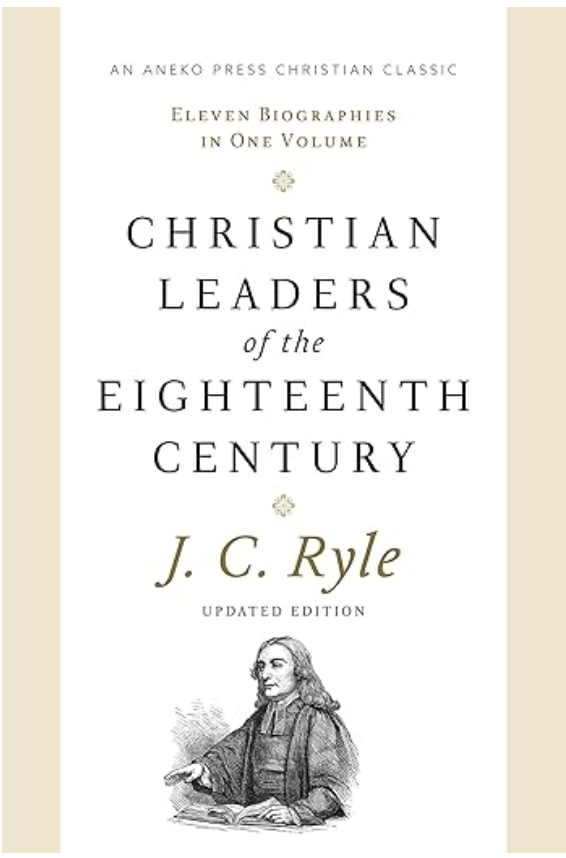
I have been reading the Kindle version of this book recently. One of the pastors highlighted in the book is William Grimshaw whose name is not very well known. He was born in 1708 in Lancashire, England. He was educated for ministry in the Church of England and was ordained in 1731. He spent some time Todmorden but was not very spiritually focused and his work there was not particularly profitable. He read Thomas Brooks’ Precious Remedies Against Satan’s Devices, and John Owen’s Doctrine of Justification by Faith and these books deeply impacted him and became a turning point in his life and ministry. Grimshaw was appointed in Haworth in Yorkshire, would embrace an evangelical ministry, and remained there until he died twenty-one years later. Little is known about the details of the call to Haworth.
Haworth proved to be a rough place with rough people but he set about preaching and doing house-to-house visitation. Some of his methods were unconventional including the fact that he would round up people during services and essentially forcibly bring them in. With this he was known as the “flogging preacher” which is of course against Christian or modern sensibilities but he was eager in his work nonetheless. He preached “repentance toward God, and faith toward our Lord Jesus Christ (Acts 2o:21) publicly and privately, just as the apostle Paul did” (pp. 94-95 of 426). He was a contemporary of George Whitefield, the Wesleys, William Romaine, and Henry Venn.
There are several aspects of his ministry that stand out to me.
Grimshaw was a man of piety and surrender.
He made this covenant with God in 1752:
“Glory be to You, O my Triune God! I desire and resolve to be wholly and forever Yours! Blessed God, I most solemnly surrender myself unto You. Hear, O Heaven, and give ear, O earth! I avow this day, the Lord to be my God, my Father, my Savior, and my portion forever! I am one of His covenant children forever. Record, O eternal Lord, in Your book of remembrance, that henceforth I am Yours forever. From this day I solemnly renounce all former lords-the world, the flesh, and the devil-in Your name. This day I give up myself to You, a living sacrifice, holy and acceptable unto You; which I know is my reasonable service” (Grace Gems, Grimshaw’s Covenant With God, December 1752).
Grimshaw was a plain preacher.
“William Grimshaw was eminently a plain preacher. His first aim undoubtedly was to preach the whole truth as it is in Jesus; his second was to preach so as to be understood” (pp. 96-97 of 426).
John Newton said of his preaching: “Though his abilities as a speaker and his wealth of general knowledge made him very capable to stand before great men, yet as his regular hearers were mainly of the poorer and more uneducated classes, he took it upon himself to adapt himself, in the most ordinary manner, to their ideas and to their modes of expression. Like the apostles, he did not like that elegance and excellence of speech that is admired by those who seek to be entertained as much as instructed from the pulpit. Instead, he chose to deliver his words in what he used to term ‘market language'”(pg. 97 of 426).
Grimshaw was a determined preacher.
It is said that at times he preached as much as 20 to 30 times per week anywhere people would gather and listen. Today, if a man preaches more than 40 times A YEAR he thinks he has really done something. Ministry and the demands of it have changed, but even so this speaks to a man who loved the Word of God and wanted to get it to as many people as possible.
Grimshaw was passionate for souls.
According to one of his biographers, not long before he died, he stood on a hill overlooking Haworth with nostalgia. He said when he first arrived there “he could have gone half a day’s journey on horseback toward the east, west, north, and south without meeting one truly serious Christian person, or even hearing of one. But now, through the blessing of God upon his labors, he could tell of several hundred people who attended his ministry…” (pg. 102 of 426). He preached at times to as many as 1200 people depending on the season.
Grimshaw endured hardship.
He did itinerant work in the towns and villages outside of his own parish which was greatly frowned upon by the Church of England. It didn’t stop him even in the face of persecution. The Rev. George White of Lancashire opposed him, made false accusations, and preached against him. A mob was eventually stirred up. When he and John Wesley went to Colne to preach in 1748 “they were attacked by an overwhelming mob of drunken people armed with clubs, and were dragged like thieves and criminals. . .The mob closed in on them as they were trying to leave and tossed them around with much violence…The people who were assembled to hear the Word of God were treated with even greater cruelty. They had to run for their lives amid showers of dirt and stones…None of these things moved the lion-hearted minister of Haworth (pp. 107-108 of 426). The next year he wrote an 86 page sermon refuting the claims of Rev. George White.
Grimshaw was humble before the Lord.
He died in 1763 in his own house, from a fever he had contracted while visiting in the home of one of his parishioners. He said before he died, “My last enemy has come! The signs of my death are upon me, but I am not afraid. No! No! Blessed be God, my hope is sure, and I am in his hands. . .Alas! What have my wretched services been? I have now need to cry at the end of my unprofitable course, God be merciful to me a sinner! At another time, laying his hand on his heart, he said, ‘I am quite exhausted, but I will soon be at home- forever with the Lord- a poor miserable sinner redeemed by His precious blood'” (pp.111-112 of 426).
In the aforementioned covenant that Grimshaw made in 1752 he wrote:
“Dispose my affairs, O God, in a manner which will be wholly subservient to Your glory and my own true happiness. And when I have done, borne, and endured Your will upon earth-call me home at whatever time and in whatever manner You please.”

